JVM Architecture: How Does the Java Virtual Machine Work?
Understanding the Java Virtual Machine - the software that enables you to run Java programs on any device with 'Write Once, Run Anywhere' capability.
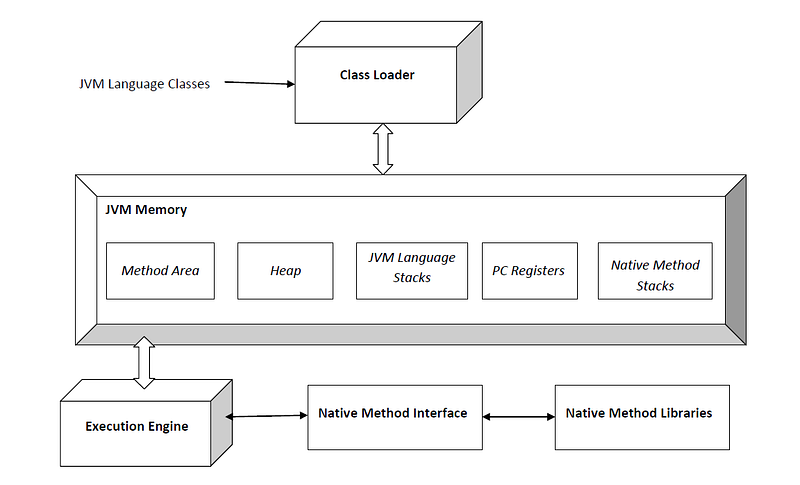
What is JVM?
JVM stands for “Java Virtual Machine,” software that enables you to run Java programs. It is a Java Runtime Environment (JRE) component that interprets and executes bytecode (.class files). Java programmers can run on any device with JVM implementation regardless of the underlying hardware and operating system (“Write Once, Run Anywhere”).
The purpose of “Write Once, Run Anywhere” will be examined in the upcoming articles.
Role of JVM in Java Ecosystem
JVM plays a central role in the Java ecosystem as it is responsible for the execution of Java programs. When Java code is compiled, it is converted into bytecode (a .class file), and the JVM’s job is to take the bytecode, which is a set of instructions that are independent of the hardware and operating system, and convert it into a program that can run on a specific hardware and operating system.
JVM Architecture
JVM architecture refers to the design and components of the Java Virtual Machine (JVM), the software that enables a computer to run Java programs. Here is a brief overview of the main components and features of the JVM architecture:
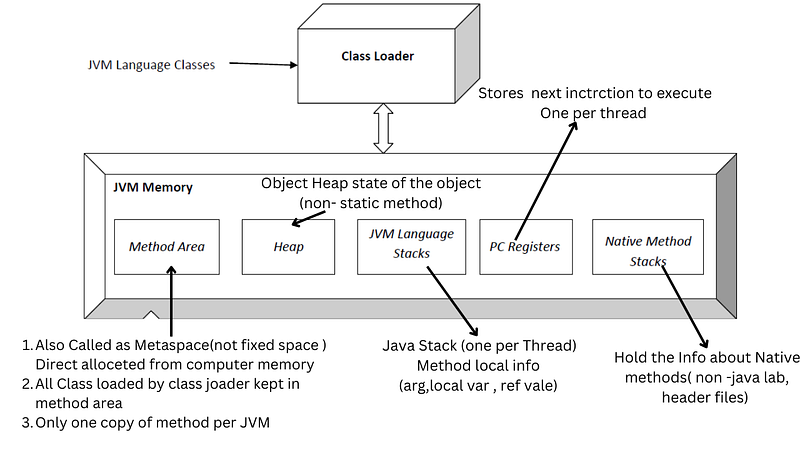
-
Class loading and execution: JVM is responsible for loading and executing Java classes. It does this by interpreting and executing the Java bytecode contained in .class files. JVM also has an execution engine and interpreter responsible for executing the bytecode instructions.
-
Thread management: JVM supports the creation and execution of multiple threads, which allows Java programs to perform multiple tasks concurrently. JVM also has a thread scheduler that determines which threads should be run at any given time.
-
Native method interface: JVM provides a native method interface, which allows Java programs to call native code, or code that is written in a language other than Java and is specific to the hardware and operating system. This allows Java programs to access features and resources unavailable through the Java API.
-
Security and sandboxing: JVM enforces security and integrity by sandboxing Java programs, which means that they are isolated from the rest of the system and are only allowed to access certain resources. This helps to prevent malicious programs from causing harm to the system or accessing sensitive information.
Conclusion
In this article, we provided a brief overview of the main components and features of the Java Virtual Machine (JVM) architecture. In the next article, we will delve deeper into each of these topics and explore them in greater detail.
Originally published on Medium